OJM Consulting & Coaching, PLLC | Nurse-led home care led by Toya, RN
Your mother says she is managing. Then you notice the untouched meals, the laundry piling up, and how carefully she holds the wall on the way to the bathroom.
You know she could use help. What is less clear is what kind of help to ask for, what it will cost, and whether a program can help pay for it.
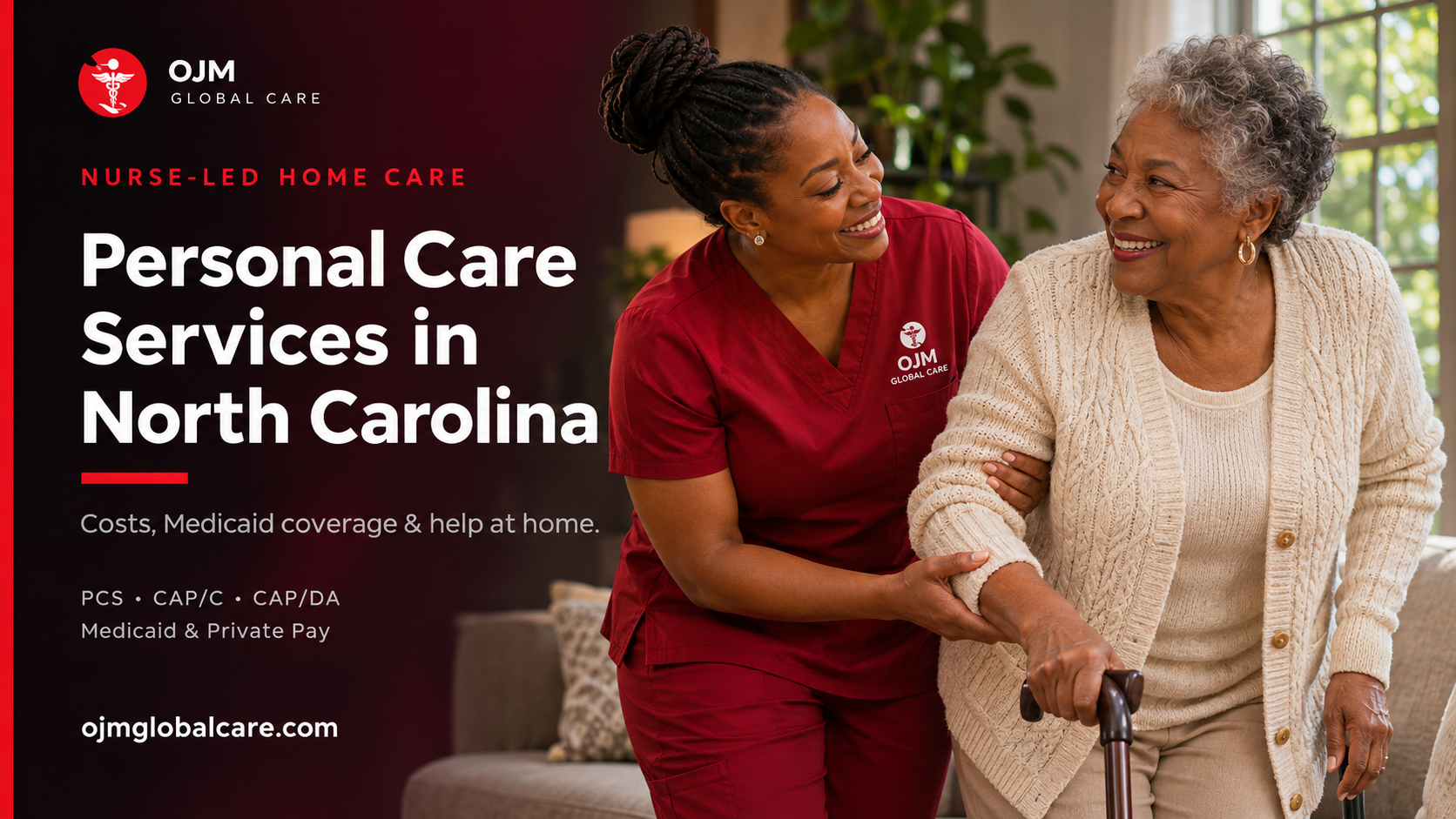
Personal care services help people with everyday activities such as bathing, dressing, eating, toileting, and moving safely. In North Carolina, families may pay privately or access assistance through Medicaid and other benefits, depending on eligibility.
OJM is a nurse-led home care agency led by LaToya, a registered nurse. We provide personal care, accept Medicaid and private pay, and provide services through Personal Care Services (PCS), CAP/C, and CAP/DA.
Based in Raleigh, we serve Wake, Johnston, Nash, Wilson, Lee, Durham, Franklin, and Orange counties, with coverage within a 60-mile radius of our office. Contact us to confirm availability at your location.
Here is how to understand your options before choosing care.
What Is Personal Care?
Personal care is assistance with daily activities that someone has difficulty completing safely or independently because of an illness, disability, memory problem, or another limitation.
Support may be needed every day or only at particular times, such as during a morning routine. The right arrangement depends on the person’s needs, preferences, and existing support.
In North Carolina Medicaid, Personal Care Services, or PCS, also names a specific benefit with its own eligibility and assessment requirements. Not every service advertised as personal care is covered under that benefit.
What Do Personal Care Services Include?
Depending on the care plan, provider’s authorized services, and payment program, assistance may include:
| Daily need | Examples of assistance |
| Bathing and grooming | Help washing, drying, and completing personal hygiene tasks |
| Dressing | Help putting on and removing clothing |
| Toileting | Help using the toilet and completing related hygiene |
| Eating | Assistance with eating as specified in the care plan |
| Mobility and transfers | Help moving between a bed and chair or getting around safely |
Some home care arrangements also include meal preparation and light housekeeping related to the person’s care.
Ask which tasks are included, which cost extra, and which your payment program authorizes.
A personal care agreement does not automatically include wound care, injections, or medication administration. Ask which tasks require a licensed clinician and who will perform them.
Who Might Need Personal Care at Home?
Personal care may help when someone regularly needs assistance with daily routines or when a family caregiver cannot provide all the support required.
Examples include:
- An older adult who needs help bathing or dressing.
- Someone whose limited mobility makes transfers difficult.
- A person with a cognitive impairment who needs assistance with daily activities.
- A child with a disability whose daily care needs require additional support.
For children, available services and funding depend on individual needs and program requirements. A disability diagnosis alone does not establish eligibility for every benefit.
Start with specific questions: What is difficult? When is help needed? What can the person still do independently?
Share those observations with the healthcare team and prospective provider. They offer a clearer starting point than guessing how many hours of care to arrange.
How Much Do Personal Care Services Cost in North Carolina?
A Place for Mom lists an average starting home care cost of approximately $30 per hour in North Carolina, based on its proprietary data. Individual agency quotes may differ.
This is a general planning figure, not OJM’s rate.
Using $30 per hour as an illustration, a consistent weekly schedule would cost approximately:
| Hours of care per week | Estimated monthly cost |
| 10 hours | $1,300 |
| 20 hours | $2,600 |
| 30 hours | $3,900 |
| 40 hours | $5,200 |
Monthly estimates use 52 weeks divided by 12 months. Actual bills depend on the agreed rate, hours delivered, and service agreement.
Before comparing quotes, give each agency the same proposed schedule and care needs. Ask about:
- Minimum visit lengths.
- Weekend, holiday, and overnight charges.
- Cancellation fees and deposits.
- Other additional charges.
- Whether rates change when care needs increase.
A lower hourly rate does not always produce a lower monthly bill. Minimum hours and additional fees can change the total.
For OJM’s current private-pay rates, call 919-371-8715 for an individual quote.
Does NC Medicaid Cover Personal Care Services?
NC Medicaid may cover personal care for eligible beneficiaries whose assessed needs meet program requirements.
PCS helps with qualifying daily activities, including eating, dressing, bathing, toileting, and mobility. Medicaid enrollment alone does not establish PCS eligibility. An assessment determines whether the person meets the care requirements, and services follow an individualized plan.
For financial eligibility questions, contact your county Department of Social Services. Ask your treating healthcare professional about the PCS referral process and confirm assessment arrangements with NC Medicaid or your health plan, as applicable.
OJM provides Medicaid Personal Care Services. Contact our office to discuss your needs, coverage, and service availability. Approval and authorized hours depend on the applicable program’s assessment and requirements.
What Are CAP/DA and CAP/C?
CAP/DA and CAP/C are separate Medicaid home- and community-based waiver programs. They have different eligibility requirements and offer support beyond standard PCS.
OJM provides services through both programs. The services available to an individual depend on their authorization, care plan, and OJM’s available services.
CAP/DA: Support for Eligible Adults
The Community Alternatives Program for Disabled Adults, or CAP/DA, supports eligible adults ages 18 and older who meet institutional level-of-care and other program requirements.
The program helps eligible people receive support at home or in the community as an alternative to institutional care. Services supplement existing formal and informal support.
Contact a local CAP/DA case management entity about referrals, assessments, and enrollment availability.
CAP/C: Support for Eligible Children
The Community Alternatives Program for Children, or CAP/C, serves eligible medically fragile and medically complex children and young people ages 0 through 20 who meet institutional level-of-care and other program requirements.
Disability alone does not establish CAP/C eligibility. The program considers medical complexity, care needs, and additional eligibility criteria.
An important financial distinction can help families who assume their income rules them out: under CAP budgeting rules, parental income is not counted toward the child’s financial eligibility. A child may qualify even when household income exceeds regular Medicaid limits.
The child must still meet the applicable financial, medical, and other program requirements. County DSS determines financial eligibility; CAP approval and its effective date affect when these budgeting rules apply.
Ask your child’s healthcare team or a local CAP/C case management entity about the referral process.
Does Medicare Cover Personal Care?
Original Medicare does not cover personal care when that is the only care needed.
It may cover part-time or intermittent home health aide services alongside qualifying skilled home health services when the other coverage requirements are met.
Eligibility includes being homebound and needing qualifying skilled care. A prior hospital stay is not required. Covered services must be arranged through the Medicare home health benefit, including its provider and care-plan requirements.
If you have Medicare Advantage, ask your plan about coverage and any additional in-home benefits.
What Other Payment Options Should Families Explore?
Depending on the person’s circumstances, other options may include:
Private pay. Families pay the agency directly under an agreed service schedule and rate.
Long-term care insurance. Ask the insurer which services and providers qualify, how benefits are triggered, and whether an elimination period applies. Filing a claim does not necessarily start that period; policy terms differ.
Veterans’ benefits. Eligible veterans and survivors may qualify for assistance through VA programs. Ask the VA or a VA-accredited representative about eligibility, including whether pension-related Aid and Attendance benefits may apply.
Special Assistance In-Home. North Carolina offers this program for certain eligible adults who need support to remain at home. Ask county DSS about its cash assistance and case management. Do not assume it will pay an agency’s entire care bill.
Confirm the terms of each benefit before relying on it to fund a care schedule.
How Is Personal Care Different From Home Health?
Personal care focuses on assistance with daily activities, such as bathing, dressing, toileting, and mobility.
Skilled home health can include nursing, wound care, physical therapy, and other clinical services ordered by an appropriate healthcare professional.
Some people need both. Ask the healthcare team which services are appropriate and confirm how each will be funded.
A nurse-led home care agency does not automatically mean every service it provides is a skilled home health service.
How Do You Choose a Personal Care Provider?
Choosing care means deciding who will enter your home and help with private daily routines. Specific questions can help you compare providers.
Check the License Independently
Ask for the agency’s legal name and license information, then check the North Carolina Division of Health Service Regulation’s licensed facility listings.
Confirm that the location and services match the agency you are considering.
If you will use Medicaid or another program, separately confirm that the provider participates in the relevant program and can deliver your authorized services.
Ask About Caregiver Absences
Care needs do not disappear when someone is sick.
Ask who arranges replacement coverage, how you will be notified, and what happens if no replacement is available.
Understand the Care Arrangement
Before agreeing to services, ask:
- Will the same caregiver usually visit?
- How are caregivers matched with clients?
- What screening and relevant training do caregivers receive?
- Who supervises care, and how is a nurse involved?
- How do we contact someone with a care concern?
- Will we receive a written care plan and full list of charges?
- How do we request changes or raise concerns?
Look for clear answers and written responsibilities.
How to Get Started With Personal Care
1. Write down the daily tasks that require help.
Include when assistance is needed and what support family members can realistically provide.
2. Speak with the healthcare team.
Explain the difficulties and ask whether personal care, skilled home health, or both should be explored.
3. Check payment options early.
Public benefits involve eligibility, assessment, and authorization steps. Ask separately about approval timelines and caregiver availability.
4. Contact a provider that serves your location.
Explain the care needs, preferred schedule, and payment route.
5. Review the arrangements before services begin.
Understand the care plan, charges, communication process, and backup arrangements.
If benefits have been denied, reduced, or terminated, read the notice promptly. Deadlines and requirements for requesting continued benefits may differ. Follow the instructions in your specific notice.
Frequently Asked Questions About Personal Care
Yes. OJM accepts Medicaid and private pay and provides services through PCS, CAP/C, and CAP/DA. Medicaid-funded services depend on eligibility, authorization, and the applicable care plan.
Call 919-371-8715 to discuss coverage or request a private-pay quote.
OJM serves Wake, Johnston, Nash, Wilson, Lee, Durham, Franklin, and Orange counties, with coverage within a 60-mile radius of its Raleigh office.
Contact the office to confirm availability for your specific address and care needs.
Yes. You can pay privately. You may also explore eligible insurance, veterans’ benefits, or other assistance programs, each with its own requirements.
Yes. Children may receive in-home support when their needs and the service arrangement qualify.
CAP/C is one pathway for eligible medically fragile and medically complex children ages 0–20. It is not the only possible Medicaid pathway; ask the child’s healthcare team about benefits appropriate to their needs, including consideration under EPSDT.
OJM also serves children with disabilities. Contact us to discuss the services available for your child.
Possibly. Under CAP budgeting rules, parental income is not counted toward the child’s financial eligibility.
The child must still meet the program’s financial, medical, and other requirements. Ask county DSS and the CAP/C case management team to assess the situation rather than ruling your child out based on household income alone.
Not necessarily. Companionship generally focuses on social support and everyday assistance. Hands-on help with bathing, toileting, or transfers may require a different service arrangement.
Ask exactly which tasks are included
Timing depends on the payment route, required assessments, service authorization, and caregiver availability.
Ask separately when services could be approved and when an appropriate caregiver could start.
Ask what concerns them: privacy, independence, cost, or having someone unfamiliar in the home.
Involve them in decisions whenever possible. A short visit for one agreed task may feel more manageable than introducing a large schedule at once. Discuss safety or decision-making concerns with their healthcare team.
Nurse-Led Personal Care Services With OJM
Choosing personal care means choosing who will help with some of your family member’s most private daily routines. You deserve to know who is behind that care.
OJM Consulting & Coaching, PLLC is a nurse-led home care agency led by LaToya, RN. We provide personal care services, accept Medicaid and private pay, and provide services through PCS, CAP/C, and CAP/DA.
We serve adults and children with disabilities, with services based on individual needs, applicable program requirements, and availability.
Our service area includes Wake, Johnston, Nash, Wilson, Lee, Durham, Franklin, and Orange counties, within a 60-mile radius of our Raleigh office.
Ask us the same questions. Who will provide the care? How is nursing leadership involved? What happens if a caregiver cannot attend? What services are covered, and what would you pay privately?
We welcome those questions because you should understand the care before it starts.
Call OJM to discuss your family’s needs, ask about Medicaid-covered services, or request a private-pay quote.
- Office: 919-371-8715
- Nurse line: 919-924-8107
- Office address: 8024 Glenwood Avenue, Raleigh, NC 27612
- Website: ojmglobalcare.com
Sources and Further Reading
- NC Medicaid: Personal Care Services
- A Place for Mom: Home Care in North Carolina
- Medicare: Home Health Services
- NC Medicaid: CAP/DA
- NC Medicaid: CAP/C
- NCDHHS: CAP Financial Eligibility Policy
- NC Medicaid: Health Check and EPSDT
- NCDHHS: Special Assistance In-Home
- VA: Aid and Attendance Benefits
- NC DHSR: Licensed Facilities
This article provides general education. Costs, coverage, eligibility rules, and availability vary. Confirm your situation with the relevant program, insurer, or healthcare professional.